


The star has handed over the complete sum of his £25,000 Mercury Prize winnings to the trust for venues, which functions to protect the United Kingdom's small live music spots.
He was awarded the prize on October 16 as his latest record People Watching was chosen as the outstanding release of the previous year.
The musician has opted to donate the funds to the Music Venues Trust, in acknowledgment of the vital role grassroots venues played in his beginning days.
"As an artist wouldn't be doing this success if it hadn't been for all the gigs I performed around the North East, and beyond, when I was starting out," remarked Fender. "These venues are renowned, but they are struggling."
From early 2023 onward, more than 150 of these venues have shut down – about 16% of the total UK scene.
In the last year, top acts such as the band Pulp, Coldplay, Katy Perry and Ed Sheeran have all aided the MVT in its efforts to keep the scene afloat, by adding a small levy to their ticket costs, which goes to help local stages.
Fender also joined in, generating in excess of £100,000 on his 2024 arena tour to help 38 local spots across England, Scotland, and Wales.
The donation supported spaces that were facing imminent closure due to challenges stemming from flooding, fire incidents and bereavements, as well as regulatory hurdles, conflicts and neighbor objections.
Other venues received funding support in modernizing amenities and sound and lighting systems that directly benefitted musicians and concertgoers.
"The notion that money from concerts in major spaces backs the local stages, where it kicks off for performers like me, is just common sense," Sam Fender has stated.
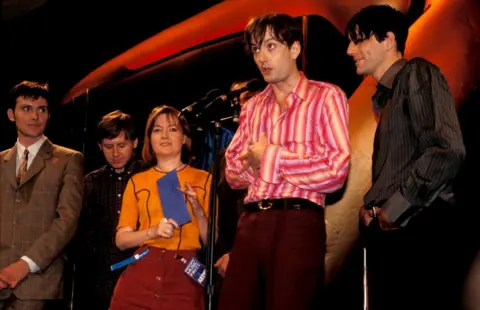
He is far from the only musician to give his Mercury Prize prize money to charitable organizations.
In they received the award in the year 1996 for their album the album, frontman Cocker stated that the act would give their cash to the non-profit War Child.
That year, musician she shared her award among several organizations, including the NSPCC and a Sickle Cell organization.
"And I contributed a thousand pounds to my local community centre, to their classes, because I practiced gymnastics when I was younger and they required new equipment," she explained to a publication.
Previously, the band gave their winnings to the community center that developed their act, in addition to other local music groups.
And 1994 winners the group donated their prize to a MS organization after a close contact was identified with the disease.
"The victory was ample," said artist Small. "The prize was the extra but we didn't require the extra, because we had the main prize. So our victory affected another person's life."
Last week, the trust announced it had rescued a couple of small stages in the South East, by bringing them into community ownership.
One venue in the city and the other in Bristol were purchased under the public acquisition scheme, which is supported by a national body and supporters who acquire "ownership units" in the venues.

